The phrase “four-season tent” typically brings to mind a heavy-duty shelter built to survive sustained snow load and sub-zero wind — not something that fits in the bottom of a daypack. That assumption raises a fair question for anyone shopping for backpacking gear: does cutting weight necessarily mean giving up cold-weather or storm capability, or can a genuinely lightweight tent still hold up outside of mild summer conditions? The answer depends less on the word “ultralight” itself and more on which specific engineering choices a manufacturer makes to reach that weight.
What “Four-Season” Actually Refers To
Before comparing any specific product, it helps to separate marketing language from the practical criteria the term is meant to describe. A tent generally earns four-season consideration based on a combination of factors: how much wind load its pole structure and anchoring system can tolerate, how well its fabric sheds sustained rain or wet snow, and whether its ventilation design manages condensation in cold, humid air rather than trapping it.
None of those criteria are inherently tied to weight — a well-engineered pole geometry can resist wind without adding significant mass, and a thin, tightly woven fabric can still carry a meaningful waterproof rating. Weight and seasonal capability are related mainly through material choices, not as a fixed rule.
Where Ultralight Design Typically Cuts Corners
That said, most ultralight tents achieve their weight savings by reducing something — fewer poles, thinner fabric, smaller vestibules, or simplified stake-out points. Any of these trade-offs can weaken a tent’s performance in wind or wet snow if not compensated for elsewhere.
This is the point where individual product specifications matter more than the general “ultralight” label: a thinner fabric with a low waterproof rating and a single unsupported pole is a very different proposition from a thinner fabric paired with a reinforced dual-anchor frame and a higher waterproof coating.
How One Manufacturer’s Design Addresses This Trade-off
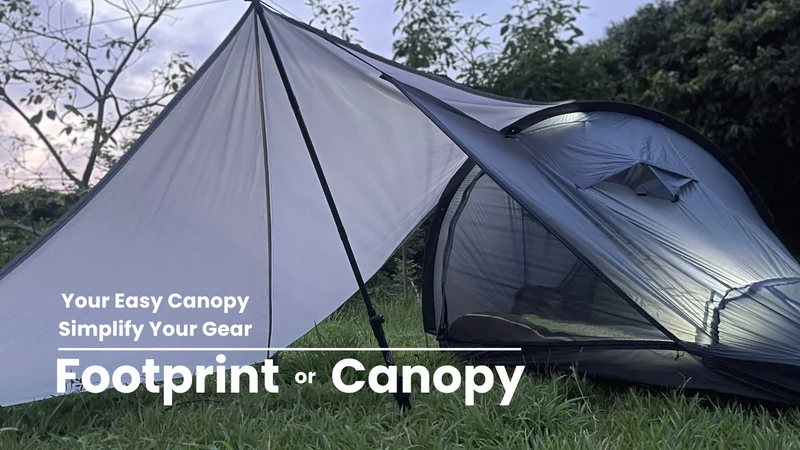
THECATAL’s Wind Anchor line of hiking tent ultralight products takes a geometry-first approach. The tent is built around the UniArc DualAnchor Shell Structure, a single-arch, dual-anchor shell with a streamlined twin-cone form that reduces wind resistance through shape rather than added material.
The standard Wind Anchor has a net tent weight of 850 g and a minimum setup weight of 992 g, counting the poles and two stakes. The Pro version brings the tent alone down to 650 g, with a minimum setup weight of 792 g, by using 10D fabric in place of the standard 20D. Both use Coatforce ripstop, a nylon with a double-sided silicone coating.
Wind resistance is a central consideration in the Wind Anchor design. Its semi-conical profile helps reduce exposure to wind, with the tent designed to withstand conditions reaching Beaufort scale level 12.
Waterproofing and Ventilation in Cold, Wet Conditions
Wind resistance addresses only part of what a shelter needs to handle across seasons; sustained rain and cold-weather condensation are separate challenges.THECATAL equips the Wind Anchor with a 5,000 mm waterproof-rated fly sheet and a 360° spoiler window system featuring a reverse-flow design.
The ventilation system is intended to maintain airflow inside the tent and reduce condensation buildup, which is particularly relevant in cold, humid conditions where moisture can accumulate on the inner walls overnight.
The product is also built to pitch in both freestanding and non-freestanding configurations, which can help with stability on terrain where standard staking isn’t reliable, such as frozen or rocky ground.
Where the Limits of “Ultralight” Still Apply
Even with reinforced wind resistance and a solid waterproof rating, it’s worth noting where the limits of a lightweight shelter lie. The Wind Anchor does not come with a stated snow-load rating or minimum operating temperature.
Both figures are important when assessing a tent for winter mountaineering, particularly in conditions involving prolonged snow accumulation and sustained low temperatures, rather than exposure to wind and rain alone.
That distinction matters for anyone planning a trip into deep-snow conditions specifically, as opposed to a shoulder-season trip involving cold nights, wind, and rain without significant snow load. A tent engineered around wind resistance and waterproofing isn’t automatically equivalent to one engineered around bearing weight on its canopy for days at a time.
Matching Specifications to the Actual Trip
The more useful question for most hikers isn’t whether a lightweight tent can technically be used across the seasons in the abstract, but whether its specific wind rating, waterproof rating, and ventilation design match the conditions of a particular trip.
For someone comparing options built for cold, windy, or wet-but-not-snow-heavy conditions, reviewing an ultralight 1p tent against its wind and waterproof figures — rather than relying on a general seasonal label — gives a clearer picture of where it will perform reliably and where its limits begin.
The Wind Anchor is sold as a bundle with a fly sheet, footprint, and accessory kit, and THECATAL backs its tents with a two-year warranty. With a 5000 mm waterproof rating, wind resistance rated to Beaufort scale level 12, and tent weights starting at 650 g, those figures can be weighed against the conditions of a specific trip instead of a broad claim of year-round capability.
