Selecting a power supplier for medical equipment is a purchasing decision that can influence product development, certification, production, and long-term supply. A supplier may offer products with suitable voltage and power ratings, but these specifications alone do not show whether the company is appropriate for a professional medical project. OEMs and equipment developers should also examine safety design, engineering verification, application compatibility, and production consistency before making a decision. Comparing medical power supply manufacturers from these perspectives can help buyers reduce avoidable problems during later development stages.
- Start With the Intended Medical Application
The first step is to define what the power solution actually needs to do. A power supply for a patient monitor may have different requirements from one used in laboratory equipment, diagnostic systems, or portable medical devices.
Before contacting suppliers, engineers should identify the required input range, output voltage, power level, operating temperature, installation method, and whether the equipment includes a rechargeable battery. The expected operating environment should also be considered.
This information gives suppliers a clearer technical starting point. It also makes comparison easier because different manufacturers can be evaluated against the same requirements rather than against general product descriptions.
For medical equipment, the relationship between the external power supply and the complete system is particularly important. A technically suitable component may still require additional evaluation after it is integrated into the final equipment.
- Examine Safety Design Before Comparing Prices
Medical applications require careful attention to electrical safety. Buyers should therefore review safety architecture before focusing on unit cost or delivery conditions.
Important points include isolation protection, leakage current, insulation structure, creepage and clearance distances, and protection against abnormal electrical conditions. The applicable certification requirements should also be confirmed according to the intended market and equipment category.
For example, the UES12LCP-SPA/UES12LCP-SPC series provides 2 MOPP isolation protection and supports BF-level medical device applications. It also incorporates short-circuit, overvoltage, and overload protection.
These specifications can be useful during supplier comparison because they provide measurable technical references. However, certification of an individual power product does not automatically mean that the complete medical device is compliant. System-level verification remains necessary.
- Look Beyond the Datasheet and Check Verification Capability
A datasheet provides important information, but it cannot show how a supplier handles real development problems. Medical equipment manufacturers should ask how products are verified and what testing is performed before production.
Electrical performance, thermal behavior, protection functions, EMC characteristics, and environmental conditions may all require evaluation. It is also useful to understand whether testing is performed during development or only after the product has been finalized.
EMC deserves particular attention because medical equipment can contain sensitive sensors, communication circuits, processors, and displays. Power conversion can introduce electromagnetic noise that may affect the complete system.
A supplier with appropriate laboratory and verification capabilities can give engineering teams more opportunities to identify compatibility issues during development rather than after final equipment integration.
- Evaluate Whether the Product Can Adapt to the Equipment
Medical equipment does not always fit a standard power configuration. Mechanical dimensions, connectors, output requirements, charging functions, and regional plug configurations can differ between projects.
This is where application flexibility becomes important. Buyers should determine whether a supplier can provide suitable configurations without requiring major changes to the complete equipment design.
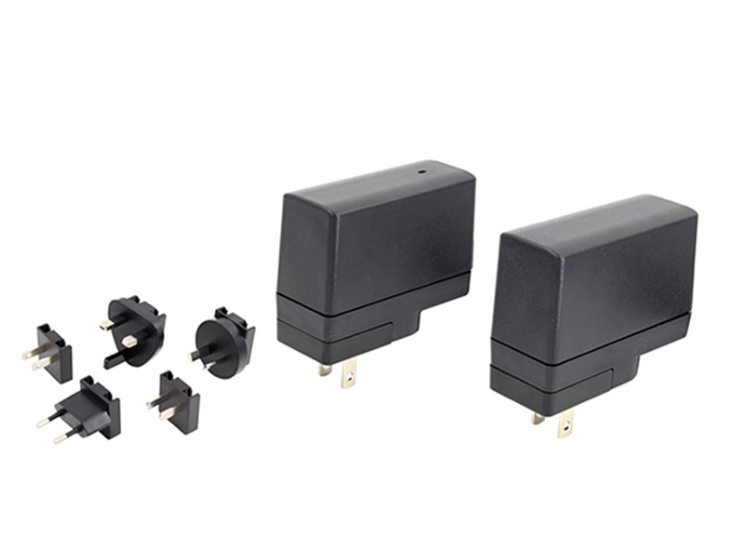
A universal AC charger adapter can be useful for projects requiring external AC-DC conversion and battery charging functions. A universal AC charger adapter can be useful for projects requiring external AC-DC conversion and battery charging. Buyers can evaluate whether a supplier offers suitable output configurations, charging-related options, and regional plug configurations for different equipment requirements.
For OEM projects, this type of flexibility can simplify product development when one equipment platform needs to address different electrical or regional requirements. However, engineers should still confirm connector specifications, charging architecture, and actual load conditions before approving a configuration.
- Assess Production Capability Before Moving to Mass Manufacturing
A supplier may provide a technically suitable sample but still create difficulties when production requirements increase. Medical equipment manufacturers should therefore evaluate manufacturing consistency before entering long-term cooperation.
Useful questions include whether production processes are controlled, whether product specifications remain consistent between batches, and whether manufacturing information can be traced when a quality issue occurs.
Production planning is particularly important for medical equipment because changing power suppliers after certification can require additional verification. A component replacement may affect electrical performance, EMC results, mechanical design, or safety documentation.
For this reason, supplier selection should consider not only the initial sample but also the company’s ability to maintain the approved configuration during future production.
How Should OEMs Compare Potential Suppliers?
A practical supplier evaluation can use a scoring system covering five areas: application understanding, safety compliance, testing capability, customization flexibility, and manufacturing consistency.
Technical teams can first confirm whether each supplier’s products meet the basic electrical requirements. Purchasing teams can then review production capability, communication efficiency, lead-time arrangements, and long-term supply conditions. Companies such as UE Electronic provide power supply solutions for industrial and medical applications, with product development focused on different equipment requirements.
This approach prevents one factor, such as price, from dominating the decision. A lower initial component cost may not provide an advantage if additional engineering work or repeated verification is required later.
For medical projects, buyers should also distinguish between standard products and solutions requiring customization. The more specialized the equipment, the more important early technical communication becomes.
Making a Better Supplier Selection
Choosing suitable medical power supply manufacturers requires a broader evaluation than comparing output voltage, rated power, or product price. Buyers should examine how a supplier approaches safety, verification, application matching, customization, and production consistency.
A universal AC charger adapter may be appropriate for medical equipment that combines external AC power with battery charging and requires flexible regional configurations. The final selection should still be based on the complete equipment architecture and applicable safety requirements.
For OEM and ODM projects, the strongest supplier relationship is built around clear technical requirements, structured verification, consistent manufacturing, and communication throughout the product lifecycle. Evaluating these factors before development begins can help manufacturers select a power partner that is better aligned with both current equipment requirements and future production plans.
