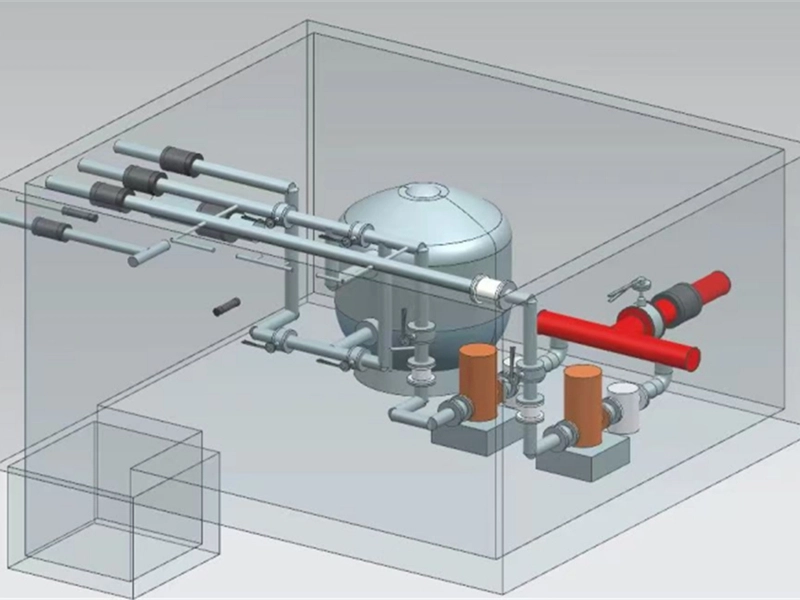
Choosing a filter type is only half of a filtration decision. The other half is sizing: how much water has to be cleaned, how fast, and in how much space. A filter that suits the pool in theory can still fail if the flow rate, turnover time, or plant room do not match. Jinchao treats filtration as part of the wider aquatic project, where circulation, treatment, and building layout are planned together.
Start With Flow Rate and Turnover
Turnover time is the period in which the whole pool volume passes through the treatment plant. Shallow, heavily used pools and splash areas need faster turnover than deep, lightly used ones, because contaminants enter more quickly. The required flow rate follows from the volume and the chosen turnover time.
Filter area is then selected so the filter operates within its rated flow. Running a filter above its rated velocity pushes fine particles through and shortens the cycle between cleanings, while running well below it wastes capital. Manufacturers’ data sheets give the permitted flow per unit area for each filter type.
Pumps and pipework must match these figures. A pump chosen for the flow rate but not for the pressure drop across a dirty filter will deliver less water than expected as the filter loads. Designers should check the pump at both clean and dirty filter conditions.
Match Filtration to Pool Conditions
Pool size alone does not determine filtration requirements. Bather load, operating hours, water volume, circulation rate, environmental exposure, and the type of aquatic activity all affect how quickly contaminants enter the water. A busy public pool may generate a very different filtration workload from a small hotel pool, even when their physical dimensions are similar.
Water chemistry also influences filtration performance. Hair, skin particles, sediment, sunscreen residue, and other pollutants need to be removed from circulation so that subsequent treatment stages can operate under manageable conditions. A properly planned commercial pool filtration system should work with chemical dosing, circulation pumps, disinfection equipment, and turnover requirements instead of being selected as an independent component.
Maintenance capability can be just as important as theoretical filtration efficiency. Facilities with limited technical staff may prefer equipment with straightforward inspection and cleaning procedures, while larger aquatic venues may have dedicated personnel capable of handling more involved media maintenance. This practical difference can significantly affect the suitability revealed by a DE vs. sand vs. cartridge filter assessment.
Consider Water, Energy, and Maintenance Demands
Backwashing is an important distinction between filtration approaches. Sand filters require periodic backwashing to remove accumulated contaminants from the media, which consumes water and produces wastewater that must be managed appropriately. Facilities operating under water-use restrictions may need to account for this recurring demand when comparing alternatives.
Cartridge-based filtration can reduce the need for routine backwashing because cleaning is performed by removing the filter elements. That does not mean maintenance disappears; cartridges still require inspection, washing, replacement, and sufficient access around the filter housing. A detailed pool filter comparison should include labor, replacement intervals, cleaning procedures, and downtime alongside the initial equipment cost.
DE filtration introduces another set of operational considerations. The filter medium needs to be replenished after cleaning, and staff must follow suitable handling procedures. Across all three options, filtration should be viewed as part of water management rather than a standalone purchase. Effective Pool Water Treatment also involves disinfection, pH control, hardness management, and water conservation, each of which affects the overall operating environment.
Build the Selection Around Long-Term Operation
Equipment sizing should begin with actual hydraulic requirements. Pump capacity, turnover targets, pipe diameter, filter flow rate, pressure losses, and available plant-room space need to correspond with one another. An oversized filter does not automatically produce a better facility, while insufficient capacity can place unnecessary pressure on the circulation and treatment process.
The operating environment should shape the final decision as well. Outdoor pools may receive more dust, leaves, and environmental debris, while indoor facilities can have different contaminant patterns and humidity conditions. A qualified water park manufacturer can help project teams examine filtration within the context of pool layout, circulation infrastructure, equipment access, and future maintenance.
Lifecycle planning can prevent a low purchase price from becoming an expensive operating decision. Replacement media, cartridge costs, water consumption, chemical demand, cleaning labor, and equipment downtime should all be considered before installation. The most useful commercial pool filtration system is the one whose technical characteristics and maintenance requirements fit the facility’s actual operating model.
Conclusion
No single filtration method suits every commercial pool, and no filter performs well if it is undersized. Sizing the plant from turnover, flow rate, and plant-room space gives the comparison between DE, sand, and cartridge options a sound basis, because each can then be judged on cleaning, maintenance, and water use at the right capacity.
Jinchao’s experience as a water park manufacturer places filtration within the wider context of aquatic facility planning, where circulation, disinfection, maintenance access, and long-term operating demands need to function together. Reviewing those factors alongside the practical differences identified in a DE vs. sand vs. cartridge filter assessment can give operators a clearer basis for selecting equipment suited to the facility’s real conditions.
