A house-wide backup project begins with a practical question: which electrical loads must continue operating, and for how long, if normal grid supply disappears? That question is more useful than starting with the largest available battery.
A whole house battery backup system has to cover energy consumption, instantaneous power demand, inverter compatibility and the physical conditions of the installation. A whole house battery backup can then be sized around the property rather than around a nominal kWh figure that may not reflect real use.
Define the Backup Target Before Looking at Capacity
Daily consumption and emergency priorities describe two different parts of the backup requirement. A whole house battery backup may be expected to run nearly every circuit, or it may be reserved for refrigeration, lighting, communications, pumps and selected appliances. Those two operating plans can require very different storage capacities even in homes with similar monthly electricity bills.
A whole house battery backup system also needs a clear autonomy target. A property that expects short grid interruptions may need only several hours of support, while a site exposed to longer outages may require most of a day or parallel battery capacity.
The calculation should therefore connect daily kWh use with the desired outage duration instead of assuming that a larger battery is always the better purchase. It is also useful to distinguish average consumption from short periods of high demand, because a home may have moderate daily energy use while still operating several high-power appliances at the same time.
Match Energy Capacity With Current Demand
Energy capacity indicates how much electricity can be stored, but current capability affects how quickly that energy can be delivered. GSOpower‘s GBP-L Series covers 48 V and 51.2 V models from 280 Ah to 628 Ah, providing about 13.44 kWh to 32 kWh per unit depending on the model. A whole house battery backup should be assessed against both household consumption and the power drawn by loads operating at the same time.
For the whole house battery backup system, standard charge/discharge current is 100 A, while maximum continuous current is 150 or 200 A depending on configuration. The 48 V models operate across 42–54.75 V and use a recommended 51.75 V charging voltage, while 51.2 V versions operate across 44.8–58.4 V with a recommended 55.2 V charging voltage. The corresponding recommended discharge cutoffs are 45 V and 48 V.
Use Runtime Examples as References, Not Guarantees
Published runtime examples are useful only when they are tied to a stated consumption range. GSOpower matches the 13.44 kWh GBP48-280L with a 10–15 kWh/day apartment or small home for roughly 20–22 hours without solar. That gives a whole house battery backup buyer a reference point, but actual duration still depends on the loads running during the outage.
The same sizing logic places the 16.1 kWh GBP48-314L at about 15–20 hours for a 15–25 kWh/day three- to four-bedroom home. A whole house battery backup system based on the 28.8 kWh GBP48-560L is matched to a 25–40 kWh/day large home or EV owner for roughly 18–24 hours, while consumption above 40 kWh/day can use the 32 kWh GBP48-628L or parallel units.
Placement, Communication and Expansion Matter
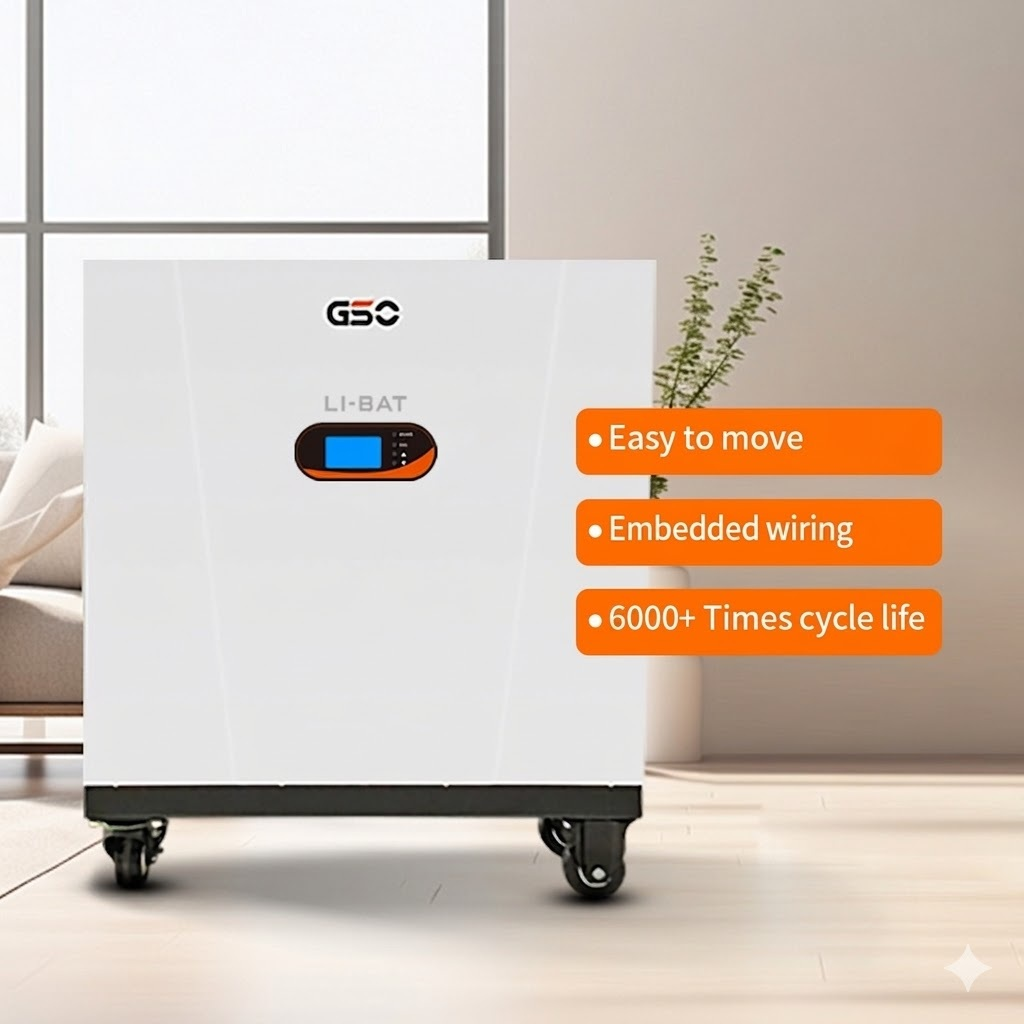
A battery used for an entire home also has to fit the property physically. The GBP-L platform uses a wheeled LiFePO4 cabinet, so a whole house battery backup does not require wall mounting and can be repositioned more easily than a fixed wall unit. Secure embedded terminals provide plug-in wiring, while the standard LCD displays battery status and allows inverter communication protocols to be selected.
The whole house battery backup system supports parallel expansion, which is important where present energy use may increase later. The product family is listed with REPT/EVE-class cells, more than 6,000 cycles and a 10-year life, while cycle life is also specified at more than 5,000 cycles at 80% DoD.
Operating range is -30 to 60°C, storage range is -20 to 65°C, protection level is IP20 and cooling is by natural air. These environmental limits affect where the cabinet can be placed and whether the surrounding space can provide suitable ventilation, access and protection from conditions outside the stated enclosure rating.
Consider How the Battery Will Be Recharged
Backup duration is only one side of resilience; the battery must also have a practical path back to a charged state. A whole house battery backup can receive solar energy through a compatible hybrid inverter, and grid power can charge it during low-tariff periods. That gives the system more than one charging source before or between outages.
For a whole house battery backup system, the purchase decision should therefore combine load priorities, daily kWh use, desired autonomy, current limits, inverter communication, installation location and future expansion.
GSOpower’s GBP-L specifications provide several capacity and runtime reference points, but no single model fits every residence. The sounder approach is to define the home’s operating requirement first and then select the battery configuration that can meet it within the stated electrical and environmental limits.
