The choice between 2D and 3D wire bending depends on what your clinic needs to fabricate. Simple planar bends work well for straightforward configurations, whereas advanced shaping is required for intricate spatial paths and custom orthodontic appliances.
As orthodontic laboratories transition to digital production, equipment choices must align with appliance geometry and manufacturing requirements. A 3d wire bending machine is not a universal necessity for every dental lab, but rather a targeted investment whose value depends on how effectively it meets actual production demands.
Does Your Clinic Need Flat Bends or True Spatial Geometry?
Two-dimensional bending primarily treats the wire as a shape developed within one plane. That approach can work well where the required geometry consists mainly of straightforward bends that do not require substantial changes in spatial direction.
Three-dimensional bending addresses a different production problem. The wire can be manipulated through multiple axes to create a more complex path. That distinction becomes significant for orthodontic appliances where curves, angles, and spatial relationships must work together.
A dental lab producing only a narrow range of conventional wire forms may have little reason to move beyond a simpler bending method. However, an orthodontic laboratory handling customized removable appliances may encounter designs that are difficult to reproduce efficiently through planar bending alone.
The WBM-V2 listed by Riton is an automatic orthodontic steel wire bending machine designed for removable orthodontic appliances. Its stated compatible wire diameter is 0.5–1.0 mm, covering a range used for different orthodontic wire structures.
What Changes When One Wire Must Follow a Three-Dimensional Design?
Complex appliance geometry changes the equipment decision because the challenge is no longer simply creating individual bends. The complete wire path must remain coordinated from the beginning to the end of the forming sequence.
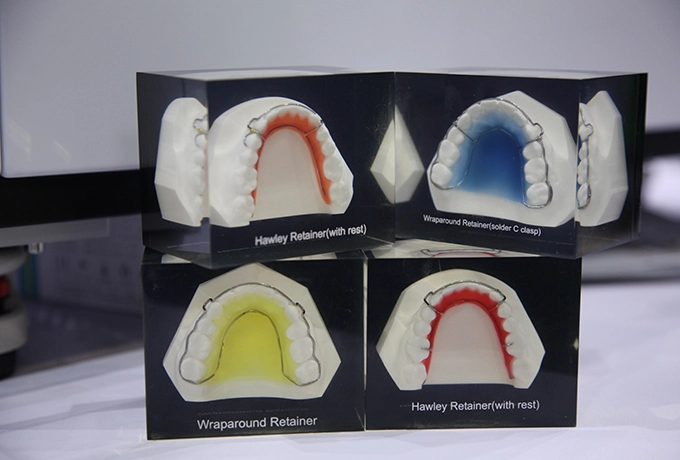
That requirement is particularly relevant to personalized orthodontic production. The supplied product information identifies structures including Hawley retainers, Begg retainers, lingual bars, space maintainers, Nance appliances, lingual arches, and other removable appliance components.
A 3D wire bending machine becomes more compelling when a dental lab needs automated production to accommodate varied designs rather than repeatedly reproduce one standard profile. The WBM-V2 uses six-axis coordinated motion and a PLC with multi-axis servo control, according to the supplied product information.
Its listed bending repeatability is ±0.5°, while feeding accuracy is specified at ±0.05 mm. Such specifications are relevant when a clinic is assessing whether automated equipment can provide the control required for its intended wire designs.
The question, therefore, is not simply whether 3D technology offers greater dimensional capability. It is whether the clinic’s actual appliance geometry requires movement beyond a single plane.
When Does Digital Control Make 3D Bending More Practical?
Digital integration can change the economics of the comparison. Manual interpretation of every wire design introduces additional production steps, particularly when case designs vary frequently.
The WBM-V2 is described as connecting with Riton Cloud & OrthoWireLab, with design data sent directly to the equipment. The platform also provides remote equipment start and stop functions, while its control system is designed to track and manage orders through the production workflow.
Its software-side path planning is also described as using 3D dynamic calculation to optimize the bending path. That matters because three-dimensional geometry is difficult to manage efficiently if technicians must translate every design into machine movements manually.
A wire bending machine supplier supporting this type of workflow can therefore become part of a dental lab’s digital manufacturing strategy rather than simply providing standalone mechanical equipment.
For practices already working with digital orthodontic designs, the ability to move from design to bending with fewer manual conversions can be more significant than the nominal difference between machine categories.
Which Machine Fits an Orthodontic Laboratory Expanding Custom Production?
An orthodontic laboratory should start by evaluating its production mix. If most orders involve simple, repeatable planar wire forms, a 2D solution may remain appropriate. Investing in additional dimensional capabilities could add complexity without necessarily addressing an existing production bottleneck.
Different production requirements may favor 3D equipment. Increasing demand for customized appliances, a broader product range, frequent design changes, or plans to establish a digitally integrated manufacturing workflow can make multi-axis bending more relevant for orthodontic laboratories.
Production speed may also influence the decision. The supplied WBM-V2 information states that standard structural components can be bent in less than 60 seconds and that complete device production is under 15 minutes. Those figures should be evaluated against the clinic’s own workflow rather than treated as universal production times.
The choice of a wire bending machine supplier also deserves attention when the equipment will become part of a broader digital manufacturing system. A supplier that provides equipment, software, and workflow connectivity may offer a more integrated solution for orthodontic laboratories than a standalone machine purchase.
Riton‘s WBM-V2 combines automated wire forming with digital design and production functions. Its stated workflow includes task scheduling, automatic processing-task sorting, and matching of wire-bending specifications with corresponding equipment.
For a clinic deciding between 2D and 3D, the strongest indicator is therefore the direction of its orthodontic production. A wire bending machine supplier should be evaluated according to how well its equipment fits that direction, not simply according to whether the machine carries a 3D label.
The Practical Decision: Match Wire Bending Technology to Laboratory Production Needs
A 2D machine makes sense when an orthodontic laboratory’s wire production requirements remain predominantly planar and standardized. A 3D system becomes more relevant when customized appliances require coordinated wire forming across multiple axes.
That distinction provides a clearer purchasing guideline than assuming newer technology is always better. Dental labs should first identify the wire geometries and appliance types they produce, then determine whether their existing processes can reproduce those designs efficiently and consistently..
Embracing personalized digital orthodontics means leveraging automated 3D bending to translate complex virtual designs into precisely formed physical appliances. Yet, striking the right balance is key—simpler clinical routines remain perfectly well-served by streamlined, conventional methods.
The right choice is therefore the machine that matches the clinic’s geometry today while making sense for the production model it intends to build next.
