Australia’s growing use of rooftop solar creates a practical challenge: electricity production often peaks before households and businesses need it. Storage shifts part of that generation into later hours. The value depends on where the system is installed, how it operates, and which loads it serves.
For project developers evaluating battery energy storage system Australia options, the first question is not simply battery capacity. It is whether the proposed design can support solar self-consumption, manage demand, or respond to changing grid conditions without creating unnecessary complexity.
Where Solar Storage Adds Value
Commercial buildings often generate solar electricity during working hours, but their demand may continue after sunset. Batteries can store surplus generation for evening lighting, refrigeration, or other planned loads. Engineers should compare daytime export volumes with actual consumption profiles before choosing usable capacity and discharge duration.
Residential installations follow a similar principle on a smaller scale. Battery scheduling can reduce grid imports during expensive periods, depending on tariff arrangements. Where backup operation is required, installers must also check whether the inverter supports islanded operation and which circuits can remain powered during an outage.
Solar farms face different constraints. Their export capacity may be limited by network connection agreements, especially when nearby generators are producing heavily. Storage can absorb selected surplus output and release it later. Financial models should reflect export limits, round-trip losses, operating costs, and expected cycling rather than assuming every stored kilowatt-hour produces savings.
How Batteries Support the Electricity Network
Grid support extends beyond storing solar electricity. Battery systems can respond quickly to changes in power demand and generation. With suitable controls, inverters, and market arrangements, larger installations may participate in frequency services or shift energy between lower-demand and higher-demand periods.
Community batteries operate closer to customers on distribution networks. They can absorb locally generated rooftop solar and discharge during periods of stronger neighborhood demand. Network operators still need to assess transformer loading, local voltage behavior, connection capacity, and dispatch rules before selecting a site or operating strategy.
Not every installation is designed for grid services. A small cabinet supporting a building may primarily serve local loads, while a utility-scale facility requires extensive grid-connection studies and protection systems. Buyers comparing battery energy storage system Australia projects should separate these duties early because control requirements and approval pathways differ substantially.
What Changes for Remote and Backup Sites?
Remote properties and off-grid facilities need storage for a different reason: solar generation varies, while essential equipment may operate overnight. Designers should estimate daily energy use, peak demand, seasonal solar availability, and the number of low-generation days the system must tolerate.
Backup power needs careful definition as well. A battery intended to bridge short interruptions may be sized very differently from one supporting several hours of operation. Critical circuits, permitted discharge depth, transfer arrangements, and charging sources should be recorded before comparing battery technologies or enclosure formats.
Hybrid systems may combine solar panels, batteries, and diesel generators. Coordinating their operating sequence can reduce unnecessary generator runtime, but controls must account for startup loads and charging limits. Maintenance access, ventilation, local temperatures, and replacement procedures also influence whether a configuration suits a remote installation.
Where a Pre-Wired Cabinet Fits
For smaller installations, equipment layout is part of system planning. A pre-wired enclosure can organize connections and reduce wiring work at the installation site. However, cabinet selection still depends on battery compatibility, protection design, cable routing, available floor space, and the installation instructions for the complete system.
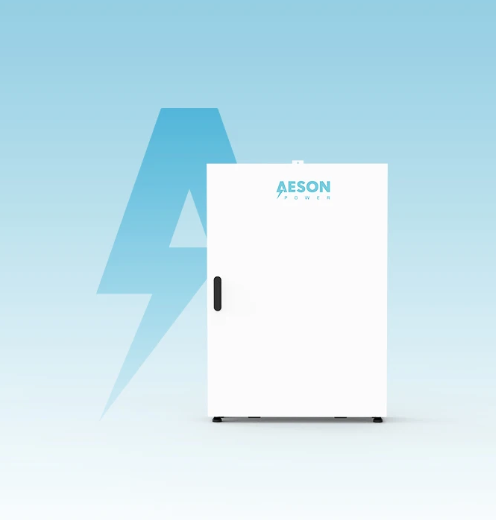
The ECO BOX offered by Aeson Power is a pre-wired enclosure with busbars, designed for wall or floor installation. The ECO-BOX-L accommodates up to two LithoDyne APS5000 battery modules, while the ECO-BOX-S accommodates up to two HaloDyne APSI2500 or APSI2500 UPS modules. Both models measure 1085 × 750 × 217 mm (W × D × H) and weigh 20 kg. These specifications describe the enclosure, not the power rating or usable energy of a completed storage system.
Such a cabinet can be considered during planning for supported modular battery arrangements. Integrators should confirm the exact module combination, inverter compatibility, protective devices, and site requirements before procurement. The enclosure alone does not establish suitability for utility-scale grid services or provide an independent claim about backup duration.
Questions That Shape a Purchase Decision
A useful procurement brief states the installation type, target loads, solar generation profile, required autonomy, and operating temperature range. It should also specify the intended charging source, space constraints, monitoring needs, and whether the project requires export control or backup isolation.
Procurement teams should request compatible equipment lists, installation drawings, test documentation, warranty terms, and support arrangements. For battery energy storage system Australia projects, local connection rules and installer responsibilities deserve equal attention. Technical review should establish what the battery, inverter, control system, and enclosure each contribute.
Reviewing lifetime costs also matters. Buyers should compare expected cycling, maintenance access, replacement procedures, and service terms against the project’s operating schedule.
From System Planning to Supplier Discussion
Storage performs different jobs across solar buildings, community networks, and remote facilities. Clear operating objectives make it easier to assess capacity, controls, compatibility, and overall project cost. No single cabinet configuration covers these applications at every scale.
As an Australian battery solutions company, Aeson Power offers the ECO BOX for specified modular battery arrangements. They can discuss compatible configurations with commercial buyers and system integrators. Contact their team with the proposed application, battery requirements, and installation details to request a suitable configuration review.
