Multi-family residential estates — apartment complexes, gated communities, and multi-building HOA properties — present a different lighting challenge than a single home. Instead of a handful of fixtures, property managers are often coordinating dozens or hundreds of units across courtyards, breezeways, stairwells, and building perimeters, all of which need to look consistent and keep working with minimal ongoing service calls. Keyida, an outdoor lighting manufacturer with 25 years of industry expertise, is one of the suppliers active in this category, and its wall-mounted product range offers a useful reference point for understanding what these installations typically require.
What Sets Multi-Family Lighting Needs Apart
A single-family home might have two or three exterior wall fixtures total. A mid-sized apartment estate can easily require dozens of the same fixture repeated across identical building elevations, plus additional units at stairwells, breezeways, and parking structures. This scale changes the priorities somewhat: consistent output across every unit, straightforward bulk procurement, and a low failure rate become more important than any single fixture’s individual design flourish. Property managers also tend to weigh maintenance access — since a failed fixture on a third-floor breezeway is more time-consuming to service than one at ground level — which makes component reliability and replaceability a bigger factor than it might be for an individual homeowner. Procurement timelines also differ: a homeowner might buy a fixture off a shelf the same week it’s needed, while a property manager sourcing dozens of matching units for a phased renovation typically needs to plan around production lead times and minimum order quantities well in advance.
Reviewing a Product Example: The G0936 Wall Sconce
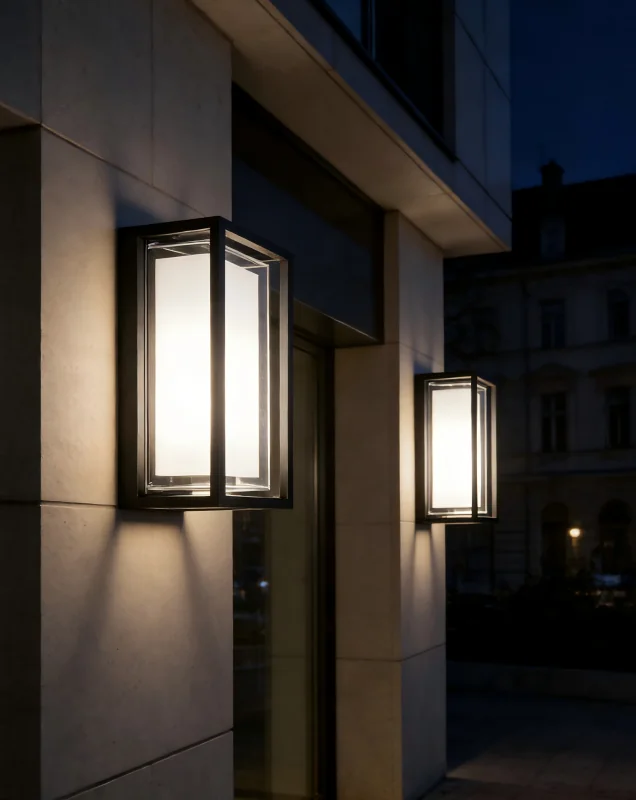
Looking at a specific product listing helps illustrate what these fixtures typically offer on a specification sheet. Keyida’s LED outdoor wall sconce model G0936 is built with a die-casting aluminum housing and a polycarbonate (PC) lampshade. It uses an Epistar SMD 12W LED chip paired with a KEDA driver, and accepts an input voltage range of 85–265V AC at 50/60Hz. It carries an IP65 rating and measures L240 × W139 × H98 mm, with a 3-year warranty. The company describes the fixture as suited to building entrances, hotel facades, and pathway-adjacent walls — applications that overlap closely with the shared entryways and building perimeters found across multi-family properties.
Keyida produces this and other wall lamp models from a 7,000㎡ manufacturing facility, where new product designs are released on a quarterly basis, largely using proprietary molds rather than shared industry designs. This can be useful for property managers who want a more distinctive fixture design and greater control over product consistency across multiple buildings.
Why Bulk Consistency Matters for Property Managers
For a single-family installation, a slight variation between two wall lights on opposite sides of a garage is rarely noticeable. Across a repeated facade pattern on a 40-unit building, the same variation — in finish, brightness, or color temperature — becomes far more visible, since residents and visitors see the pattern repeated dozens of times along a single elevation. This is one reason bulk orders from a single manufacturer and product line, rather than combining fixtures from multiple suppliers, tend to produce a more visually cohesive result across a large property. It also simplifies future maintenance, since replacement units sourced later from the same product line are more likely to match existing fixtures already installed.
Maintenance Considerations Across Multiple Buildings
Serviceability becomes a more prominent concern at scale. A fixture with a replaceable LED chip and driver allows a single failed component to be swapped without removing the entire housing — a detail that matters more when a maintenance team is managing lighting across an entire property rather than a single residence. LED outdoor wall lighting with an IP65 rating is also generally better suited to the varied microclimates found across a large property, where some fixtures may face more direct rain or humidity exposure than others depending on building orientation and overhang coverage.
Warranty terms also carry more weight at scale. A 3-year warranty covering dozens or hundreds of units represents a more meaningful commitment from a supplier than the same warranty applied to a handful of fixtures, and it gives property management teams a clearer basis for budgeting eventual replacements or repairs as part of a longer-term maintenance plan.
Matching Fixtures to Different Zones on the Property
Not every location on a multi-family estate has identical lighting needs. Building entrances typically call for higher, more consistent output to support security and wayfinding, while breezeways and stairwells may prioritize even coverage over sheer brightness to avoid harsh contrast between lit and shadowed areas. Perimeter walls facing a street or parking area often benefit from a wider beam spread than a narrower accent-style fixture would provide. Reviewing a manufacturer’s broader product range — rather than selecting a single model for every application — tends to produce a more functional result across a property with varied architectural zones. Coordinating these choices early in a renovation or new-build project, rather than fixture-by-fixture as each building phase is completed, also tends to reduce the chance of ending up with mismatched styles across a property developed over several years.
A Practical Starting Point
Multi-family residential lighting decisions generally come down to balancing consistency, serviceability, and appropriate output for each zone of the property. Clear specifications, scalable proprietary designs, and replaceable components can make long-term lighting projects easier to manage. For property managers, these features simplify planning and maintenance, whether the project involves one building or a larger development completed through multiple construction and renovation phases.
