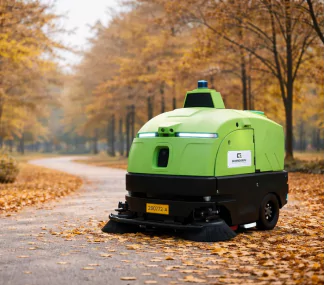
Maintaining clean parking facilities is essential for commercial properties, shopping centers, transportation hubs, industrial parks, and residential communities. Clean parking areas not only improve appearance but also contribute to safety, customer satisfaction, and operational efficiency. As labor costs continue to rise and facility managers seek more productive cleaning solutions, many organizations are evaluating the capabilities offered by modern parking lot sweeper companies.
Today’s cleaning equipment manufacturers offer far more than traditional sweeping machines. Autonomous operation, electric power systems, intelligent navigation, and multi-functional cleaning capabilities are becoming important factors when selecting a parking lot sweeper solution. Understanding how efficiency is measured can help buyers make informed decisions when comparing suppliers
What Defines Efficiency in a Parking Lot Sweeper?
Many buyers initially focus on cleaning speed when evaluating equipment. However, true efficiency involves multiple factors that affect long-term performance and operating costs.
Key evaluation criteria include:
Cleaning coverage per hour
Labor requirements
Runtime per charge or fuel cycle
Debris collection effectiveness
Obstacle avoidance capabilities
Maintenance requirements
Environmental impact
Adaptability to different parking environments
Modern parking lot sweeper companies increasingly compete on their ability to deliver a combination of these benefits rather than focusing on a single performance metric.
Cleaning Productivity and Coverage
One of the most visible indicators of efficiency is the amount of area a machine can clean during a shift.
For example, the Greendorph YJ130 autonomous sweeper delivers a cleaning efficiency of approximately 5,760 square meters per hour and operates for 6–8 hours on a single charge. The machine combines sweeping with suction, airflow assistance, and misting functions to improve debris collection while reducing dust dispersion.
The Greendorph YJ80 provides an even larger cleaning width of 140 cm and a cleaning efficiency of approximately 10,800 square meters per hour. Designed for urban environments, parking structures, plazas, and commercial properties, it combines sweeping, vacuuming, blowing, water spraying, and high-pressure washing functions in a single unit.
When comparing a parking lot sweeper, buyers should evaluate whether the machine can consistently maintain cleanliness across the entire facility rather than simply focusing on peak performance figures.
Labor Reduction as an Efficiency Metric
Labor represents one of the largest ongoing expenses associated with parking lot maintenance. Consequently, many facility managers now consider labor optimization to be one of the most important measures of efficiency.
Traditional sweeping equipment typically requires dedicated operators throughout the cleaning process. By contrast, modern autonomous systems can significantly reduce manual involvement through intelligent navigation and automated task execution.
Greendorph’s YJ130 utilizes autonomous navigation technology designed to perform routine cleaning with minimal operator intervention. The company positions autonomous cleaning as a way to reduce labor costs while maintaining consistent cleaning performance across large outdoor areas.
For cleaning contractors and property management companies, reduced labor dependency can improve profitability while helping address ongoing workforce shortages.
Electric Operation and Sustainability
Another factor increasingly used to compare parking lot sweeper companies is environmental performance.
Many older sweepers rely on combustion engines that generate emissions and noise. Modern electric cleaning equipment offers several operational advantages:
Lower noise levels
Zero direct emissions
Reduced fuel costs
Improved suitability for mixed-use environments
Enhanced sustainability initiatives
Greendorph’s outdoor cleaning equipment lineup is fully electric and designed for applications such as parking areas, campuses, industrial parks, and public facilities. The company highlights electric operation as a way to support both environmental goals and operational efficiency.
As environmental regulations continue to evolve, electric-powered cleaning equipment may become increasingly attractive for facility owners and contractors.
Navigation Technology and Safety Performance
Efficiency is not limited to cleaning productivity alone. The ability to operate safely and consistently within busy parking environments also plays an important role. Modern parking lots present a variety of challenges, including moving vehicles, pedestrian traffic, shopping carts, curbs, barriers, and constantly changing layouts. Advanced navigation systems help reduce interruptions and improve operational reliability by enabling cleaning equipment to adapt to these dynamic conditions.
The YJ130 incorporates autonomous navigation, obstacle avoidance technology, and multi-sensor perception systems designed to navigate complex outdoor environments. These capabilities allow the machine to continue cleaning efficiently while adapting to changing conditions.
Multi-Function Capability Improves Operational Efficiency
Another trend among modern manufacturers is the integration of multiple cleaning functions into a single machine. Instead of deploying separate equipment for sweeping, vacuuming, dust suppression, and washing, many organizations prefer multi-functional systems that reduce equipment requirements, simplify operations, and improve overall efficiency. The Greendorph YJ80 exemplifies this approach by combining multiple cleaning capabilities into one integrated solution.
This versatility enables facility managers to address a wider range of cleaning tasks using a single parking lot sweeper, reducing equipment complexity and improving operational flexibility.
Choosing The Right Parking Lot Sweeper Company
No single solution is ideal for every facility, as the most suitable supplier depends on operational goals, property size, budget, and cleaning requirements. When comparing parking lot sweeper companies, decision-makers should evaluate factors such as cleaning productivity, autonomous capabilities, runtime and charging efficiency, safety features, environmental performance, maintenance support, and the strength of distributor and service networks. Organizations that take a comprehensive approach to these considerations are more likely to achieve long-term operational value rather than focusing solely on initial purchase costs.
Conclusion
The definition of efficiency has expanded significantly as cleaning technology continues to evolve. Modern parking lot sweeper companies now compete through automation, electric operation, intelligent navigation, and multifunctional cleaning capabilities rather than simple sweeping performance alone.
For property managers, cleaning contractors, and facility operators, selecting the right parking lot sweeper requires a balanced evaluation of productivity, labor savings, sustainability, and operational flexibility. Through solutions such as the autonomous YJ130 and multifunctional YJ80, Greendorph demonstrates how modern cleaning technology can help organizations maintain cleaner parking facilities while improving efficiency across daily operations.
