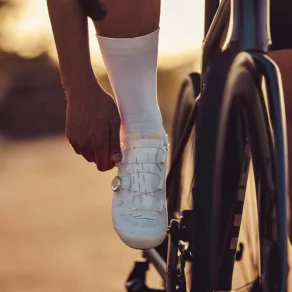
In the deeply competitive realm of road racing, the ultimate outcome of a grueling, multi-hour endurance event is incredibly often decided within the chaotic, fiercely contested final two hundred meters. When the peloton shatters and the sprint train unleashes its designated finisher, athletes call upon fast-twitch muscle fibers to generate explosive, instantaneous wattage. In these critical, high-velocity seconds, physical strength must be perfectly matched by absolute mechanical perfection. Every single component on the bicycle is subjected to extreme stress, but the primary point of energy transfer—your footwear—bears the heaviest burden. For dedicated athletes who embrace the empowering Santic philosophy of “Cycling For Freedom,” mitigating equipment inefficiency is an absolute priority. To understand how to cross the finish line first, we must deeply analyze the specific physics of a maximum-effort acceleration, and explore exactly why elite carbon sole cycling shoes are specifically engineered to completely eradicate energy leaks during a sprint.
The Biomechanics of Sprinting in carbon sole cycling shoes
To fully comprehend the structural demands placed upon racing footwear, one must first dissect the unique biomechanics of a sprint finish. Unlike a steady, seated endurance effort, an out-of-the-saddle sprint involves incredibly violent, high-cadence pedaling. Professional and elite amateur racers can frequently generate anywhere from 1,200 to 1,500 watts of peak power during this fleeting window. When a rider throws their body weight over the handlebars and forcefully drives their legs downward, the mechanical forces exerted upon the pedal spindle are absolutely massive.
If an athlete attempts this explosive maneuver wearing entry-level footwear composed of injected nylon or fiberglass mixtures, the sole will inevitably bow and deform under the immense pressure. This structural deformation acts precisely like a mechanical sponge, quietly soaking up precious kinetic energy that should be propelling the bicycle forward. By stark contrast, top-tier carbon sole cycling shoes are constructed from highly advanced aerospace-grade materials. This specialized material science ensures that the sole remains completely unyielding. When your leg muscles fire with maximum intensity, this rigid platform instantly channels every single ounce of human effort directly into the drivetrain, resulting in immediate, unadulterated acceleration.
Eradicating Torsional Deflection for Zero Power Loss
While vertical rigidity is essential for the downward thrust, a true sprint effort is never a perfectly linear motion. As the rider aggressively throws the bicycle frame from side to side to generate leverage, the footwear is subjected to intense, twisting forces known as torsional deflection. This lateral twisting is a hidden, often overlooked energy thief. If the sole flexes sideways even a fraction of a millimeter during the chaotic side-to-side motion of a sprint, the power transfer is severely compromised, and the rider’s raw speed is noticeably blunted.
This precise engineering challenge is exactly what inspired the highly celebrated Santic Stiffness 13 Series. By meticulously analyzing the exact directional forces applied during a sprint, engineers strategically layer high-hardness carbon fiber to resist both vertical bending and torsional twisting simultaneously. This highly sophisticated layup process completely immobilizes the sole across multiple geometric planes. The ultimate, highly coveted result is a technological standard appropriately named “Zero Power Loss.” When wearing footwear equipped with this elite Stiffness 13 rating, athletes can violently torque the pedals in the heat of a bunch sprint with the absolute confidence that the rigid structural matrix will not fail them.
Synchronizing Material Rigidity with Anatomical Stability
An ultra-stiff carbon foundation is only one-half of the sprinting equation. The phenomenal rigidity of the Stiffness 13 Series must be flawlessly synchronized with the shoe’s upper construction to be truly effective. During a sprint, as the foot aggressively pulls up and pushes down at over one hundred revolutions per minute, any internal foot movement completely negates the advantages of the stiff sole. If your heel lifts or your instep shifts laterally, wattage is instantly wasted through internal friction.
To combat this, Santic carefully engineers its high-performance racing footwear with advanced stabilization technologies. By utilizing highly precise micro-adjustable dials and unyielding, high-density synthetic uppers, the shoe creates an immovable “second-skin” wrap. Furthermore, integrated PEBAX heel cups deeply anchor the rear of the foot, ensuring the Achilles tendon is physically locked into optimal alignment. This brilliant anatomical synchronization ensures that the rider’s foot and the unyielding carbon base act as a single, unified mechanical lever. It is this exact holistic design approach that guarantees maximum velocity when you launch your final attack toward the finish line.
Conclusion: Equipping for the Final Attack
Mastering the explosive art of the sprint finish requires a profound combination of rigorous physical conditioning, flawless timing, and technologically superior equipment. By actively recognizing the detrimental effects of vertical deformation and torsional flex, ambitious racers can make highly educated decisions about their gear. Upgrading to the uncompromising rigidity found in elite carbon sole cycling shoes is a fundamental necessity for any athlete looking to decisively win the final sprint. Santic remains deeply, steadfastly committed to its grand vision of becoming a world-leading brand in modern cycling equipment. By successfully fulfilling its mission to provide professional, highly functional gear for those who love the exhilarating freedom of riding, the brand empowers cyclists to shatter their own performance ceilings. When you secure your feet inside the Stiffness 13 Series, you significantly reduce energy loss, ensuring that your ultimate athletic potential is fully realized on the open road.
