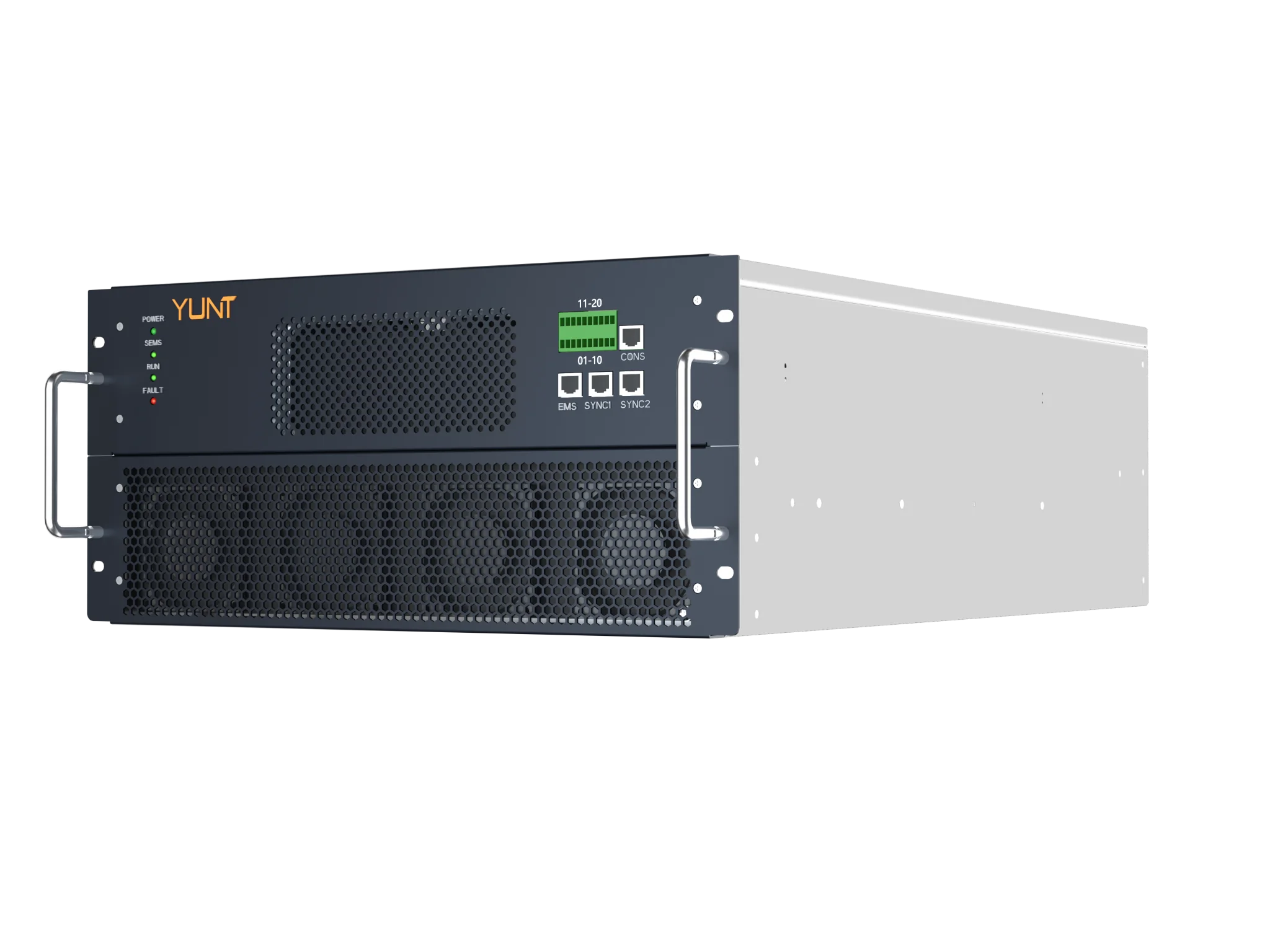
Commercial and industrial energy storage projects rarely remain static after installation. Load patterns can change, additional battery capacity may be added, and different sites can require different power ratings even within the same project portfolio. That makes modular architecture particularly relevant to system integrators.
A PCS module separates power conversion into repeatable building blocks, giving cabinet designers greater freedom in how capacity, redundancy, maintenance, and expansion are handled. YUNT develops modular conversion equipment for C&I storage applications, where system flexibility can matter as much as nominal output.
How Modular Architecture Changes Cabinet Design
Traditional centralized designs concentrate conversion functions into a larger unit. Such an arrangement can simplify certain layouts, but a fault in a major conversion section may affect a substantial portion of the cabinet’s available power. Modular architecture distributes that function among smaller units, creating more options for system configuration.
Capacity can be matched more closely to the required load. Instead of selecting one large converter that significantly exceeds the project’s initial requirement, integrators can combine modules according to the desired power level. This approach becomes particularly useful when storage cabinets need to serve different commercial facilities.
The cabinet’s internal layout can also be standardized around repeatable module dimensions. Compact conversion units fit into common mounting positions, while DC bus connections, AC output paths, and communication wiring follow consistent interface patterns. This standardization reduces the engineering effort required for each new cabinet design, since the electrical and mechanical layout does not need to be redeveloped for every project.
Supporting Flexible Power Expansion
Energy storage demand may grow after the initial installation. A factory could add battery capacity after expanding production, while a commercial building might increase its storage requirement after adding EV charging or renewable generation. Modular conversion makes these changes easier to accommodate within an existing system concept.
Parallel operation is an important part of that flexibility. Multiple conversion units can work together to provide a higher aggregate power output while retaining individual control functions. The control architecture coordinates active and reactive power sharing across modules, so adding capacity does not require replacing the existing units or redesigning the overall system topology.
Bidirectional conversion supports applications where charging and discharging requirements vary throughout the day. A China bidirectional power module moves electricity between the battery and AC network in either direction, covering peak management, renewable integration, and backup operation within one equipment set.
Improving Maintenance and System Availability
Maintenance becomes more manageable when the conversion stage is divided into identifiable modules. Technicians can isolate an affected unit and inspect or replace it without necessarily dismantling the entire cabinet. The practical benefit depends on system design, spare-part planning, and the ability to maintain safe operation during service.
Modularity can also provide a degree of operational resilience. If the cabinet architecture supports partial operation after one module is unavailable, some storage capacity may remain usable while maintenance takes place. This behavior should be verified against the specific control strategy rather than assumed from the word “modular” alone.
Fault reporting becomes more actionable when each module communicates its own operating data to the cabinet controller. Maintenance teams can distinguish between a module-level issue and a system-level condition without physically testing every unit.
Matching Conversion Technology With Site Conditions
Power density matters when cabinet space is limited. Higher conversion capacity within a compact footprint can leave more room for battery components, thermal management, protection devices, or auxiliary systems. Physical dimensions should still be considered alongside cooling requirements and service access.
Electrical characteristics are equally important. Voltage range, current capability, harmonic distortion, power factor, overload behavior, and off-grid performance all influence whether a module fits the intended application. A cabinet designed around the wrong electrical envelope can create limitations that are difficult to correct later.
YUNT’s Mars series includes the Mars-100KT, Mars-110KT, and Mars-125KT air-cooled modules. The rated charge/discharge power is 100 kW, 110 kW, and 125 kW respectively, with maximum values of 120 kW, 132 kW, and 150 kW. Each module operates within a 680–1000 V DC range and provides 400 V AC output, with Ethernet/RS485/CAN communication and up to 98.90% maximum efficiency. The series supports parallel expansion, high- and low-voltage ride-through, and off-grid parallel operation.
Balancing Standardization With Project Flexibility
Modular systems are most useful when standard components can accommodate different project configurations. System integrators can develop repeatable cabinet designs while adjusting the number of conversion units according to the site’s power requirements. This reduces the need to create an entirely different electrical architecture for every installation.
The approach also supports broader energy strategies. C&I cabinets may operate alongside photovoltaic generation, backup sources, or microgrids, each introducing different power-flow requirements. A modular conversion layer gives the system designer more room to coordinate these functions without placing every task inside one large conversion block.
From procurement to long-term service, standardization can influence the total project workload. Familiar module dimensions, interfaces, and communication methods may simplify engineering documentation and technician training across a portfolio. The real advantage comes from combining that repeatability with enough configuration freedom to accommodate site-specific conditions.
A Practical Path Toward Scalable Storage
C&I energy storage is increasingly shaped by projects that need to evolve rather than remain fixed. Modular conversion provides a way to adjust power capacity, manage maintenance, and adapt cabinet architecture without abandoning a standardized design philosophy. A PCS module can serve as the building block, while bidirectional power conversion supports controlled energy exchange between battery and grid-side equipment.
YUNT‘s modular approach reflects this broader engineering direction, offering conversion units that combine multiple power ratings, communication interfaces, protection functions, and parallel operation within a common platform. Such architecture gives system integrators more practical room to design storage cabinets around the actual demands of commercial and industrial sites.
